How to Choose Your Next House After a Home You Loved
How do you choose your next house when nothing measures up to the one you loved?
In Seattle and King County, score every house against two written lists: what your family needs daily and what made the old place feel like home. Never score it against the old house.
Every house you tour feels like a downgrade for a simple reason: you are comparing a blank page to a book you have read a hundred times.
Your old home came with years of memories attached. You knew which stair creaked, where the morning light landed, and how the backyard sounded in August. The new house has none of that yet. It has paint, square footage, and a stranger’s furniture. Of course it loses.
This feeling is fixable, and it does not mean you are doing anything wrong. This guide gives you a method for judging houses fairly, from Shoreline to Bothell to the Eastside, so you can pick a home on purpose instead of drifting through tours feeling vaguely let down.
Why Every House You Tour Loses to the Old One
Your brain is running an unfair contest. The old house gets to compete with its best moments: the holiday dinners, the first snow, the kid’s height marks on the doorframe. The new house gets judged by a twenty-minute showing with the seller’s candles burning.
No house wins that fight, whether it has cedar trees, a lake view, or a perfect kitchen. Three things stack the deck against every showing.
- Memory edits out the flaws. You forgot the drafty bedroom and the driveway that flooded every November.
- The old house was customized by you. Years of small fixes turned it into your house. A new place has had none of that work yet.
- You are still in transition. If you sold, relocated, or both, part of you is still grieving the place. That shows up as pickiness.
Grief about a sold home is normal
If you sold a house you loved, or left one behind to move to the Seattle area for work, missing it does not mean you made a mistake. It shows the home mattered. In my experience, many buyers feel a real sense of loss after a move, even one they chose and planned.
Give that feeling a place to live. Take photos of your favorite spots in the old house. Write down what you loved. You will use that list in a minute, and it turns a vague ache into something you can actually work with.
What you want to avoid is letting the feeling make the decision. Grief says, “Nothing is good enough.” A better question is, “What would a good-enough house have to include?” The rest of this guide answers that.
If you sold first and are now buying, the order of those two moves changes how much pressure you feel. My Seattle move-up buyer page explains how the sell-and-buy timing can work, and my blog post on selling before buying in Seattle covers the trade-offs.
The Two-Lists Method
Instead of comparing every house to the old one, write two lists before you tour another house. Then score each house against the lists. The old house is not allowed to be a judge.
List one: what your family needs every day
This is the practical list. It covers what has to work on a Tuesday morning in February, not what looks good in a listing photo. Put these on it:
- Space you will really use. How many bedrooms, how many people working from home, whether anyone needs a quiet room for calls.
- A commute you have tested at real hours. Drive it. Not on a Sunday afternoon. Drive it at 7:45 on a weekday morning and again at 5:15 in the evening. Between Seattle, the Eastside, Shoreline, and Bothell, the same drive can feel completely different at rush hour than it does on a weekend. If you work remotely a few days a week, test the days you do commute.
- School logistics, checked on the district’s own boundary tool. If you have school-age children, find out which school an address is assigned to by typing it into the district’s official lookup. Seattle Public Schools has an address lookup, the Shoreline School District offers a school and bus service lookup, and the Northshore School District, which serves areas such as Kenmore, Bothell, and parts of Lake Forest Park, has an online boundary tool. Boundaries change, so check the address itself, never a listing description or a neighbor’s memory. I will not rate schools for you here. That is your call, and the district can answer the logistics questions.
- A payment that fits. Not the payment that technically qualifies. The one that leaves room for groceries, travel, repairs, and sleep. More on that in a moment.
- Maintenance you can live with. A big yard is lovely until you own the weekend that comes with it.
List two: what made the old place feel like home
This is the emotional list, and it matters just as much. Most people skip it, then wonder why a perfectly sensible house feels flat. Go through your old home and ask what actually made you feel settled there. Common answers include:
- Trees and greenery. Many people who love the Pacific Northwest find that tall evergreens outside the window do more for them than a granite counter.
- Privacy. Maybe you could not see your neighbors, or the yard felt like a room of its own.
- A yard or outdoor spot. A deck for morning coffee, a flat patch for the dog, a place for the garden.
- Noise level. Some people sleep best in a hush. Others like the sound of a neighborhood. Know which one you are, and know how much road, flight-path, or train noise you can tolerate.
- The feel of arriving. A long driveway, a front porch, a quiet street, a house that sits back from the road.
Be specific. “Nature” is too vague to score. “Mature trees visible from the kitchen and the main bedroom” is a line you can check at a showing.
Score every house against the lists
Give each house a simple mark on each line: meets it, partly meets it, or misses it. Keep it quick. Do it in the car right after the showing, while the details are fresh.
| Line item | List | House A | House B |
|---|---|---|---|
| Commute tested at real hours | Daily needs | Meets | Partly |
| Payment fits comfortable budget | Daily needs | Meets | Meets |
| School logistics checked on district tool | Daily needs | Meets | Meets |
| Trees visible from main rooms | Home feel | Partly | Meets |
| Privacy in the backyard | Home feel | Misses | Partly |
| Noise level at 8 a.m. and 6 p.m. | Home feel | Meets | Misses |
That is a sample, not a real property. The point is that a house will rarely meet everything. Some lines are dealbreakers and some are nice-to-have. Mark your two or three non-negotiables so a house that misses one is out, no matter how pretty the staging.
You will also notice something useful. Houses you used to dismiss as “not like the old one” often score well. And the house that gave you a jolt of excitement sometimes misses three lines on list one. The paper does not get swept away by a nice staircase.
Want a second set of eyes on your scorecard? My touring homes guide walks through how to look at layout, light, and structure beyond the staging.
Set Your Real Budget Number and Tell the People Around You
Your lender gives you a maximum, the most a bank is willing to lend based on its formulas. Your life may fit a lower number.
Your real budget is a number you choose, after looking at your actual monthly spending, your savings goals, and how much cushion you need. Sit down with a lender or a financial advisor to work through it. The Consumer Financial Protection Bureau’s home buying guide walks through preparing a budget and comparing loan options, and it is a good free starting point. I cannot give you tax or investment advice, and I will not pretend to. A lender or advisor can run your numbers.
Once you pick the number, write it down. Then do the part most buyers skip: tell your friends and family.
Why telling people matters
Picture a couple, Dana and Marcus, who have decided on a comfortable number. (They are a hypothetical couple, not real clients.) Within a week, a friend texts them a link to a home that is well above that number. Then a relative sends another. Each link is a beautiful house with a bigger kitchen, a bigger yard, and an inspiring view.
Now the houses Dana and Marcus can afford start to feel like a step down, though nothing about those houses changed. The comparison is unfair, because the other houses live in a different budget.
If everyone around you knows your number, the links stop. The friend who wants to help sends houses that fit. You stop shopping in a neighborhood you were never going to buy in, and you stop feeling a loss that is really just a mismatch of price.
Say something simple: “We are looking in this range. If you see something that fits, send it. If it is above that, please hold off.” Most people are glad to be told.
Do the same with yourself
You are the person most likely to send yourself the out-of-range link. When you catch yourself scrolling past your number, close the app. Set your search filters to your real budget and leave them there. A saved search that never shows you what you cannot buy protects you from the comparison all by itself.
Price is only part of the cost. The cost of buying a home page lays out what else to plan for.
Layout Beats Square Footage
Here is a common trap. Someone comes from a big house and assumes the next one has to be big too. Then they tour a smaller house with a clever floor plan and feel nothing, because the number on the listing sheet is smaller than the number from before.
Square footage tells you almost nothing about how a house lives. A well-planned smaller house can feel roomier than a larger one with a wasted hallway, a formal living room nobody uses, and a kitchen cut off from everything else. A family of five can live very well in a smaller house if the layout works for the way they actually move through a day.
When you tour, look past the total and look at these things instead.
Where people eat and gather
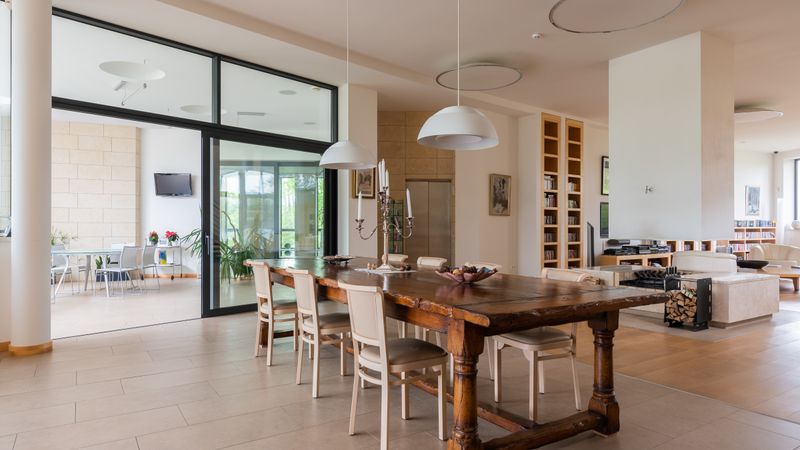
Think about where your family actually ends up at 6 p.m. In most homes it is the kitchen. Can people sit, cook, and talk at the same time? Is there a table that fits everyone, including guests at the holidays? A great room that connects the kitchen to the living area often does more for daily life than two extra bedrooms.
Where the noise goes
Walk the house and listen. Is the bedroom wall shared with the garage? Does the TV room sit right under a bedroom? If someone works from home, is the office far enough from the kids’ play area to take a call? A house can have plenty of space and still be loud, simply because the rooms are arranged poorly.
Outdoor space
Outdoor space is part of the house, not an extra. A small yard with good privacy, a covered patio, or a deck that gets afternoon sun can give you a room you use half the year. Notice what you can see from the yard and whether it feels like your own spot. If outdoor time was a big part of what made the old house feel like home, this belongs on list two with a clear description.
Storage and flow
Check closets, a place for coats and shoes, and how you enter the house from the car with groceries. These little pieces decide whether a house feels easy or annoying within a week of moving in.
Bring your lists to every showing and ask, “Where would we actually sit? Where would we put the backpacks? Where would I take a call?” If you can picture it, that is a good sign. If every answer is “I guess we would figure it out,” mark it as a miss.
Renting While You Look: Fine, With a Deadline
Many buyers sell first, or relocate first, and rent for a while. Renting while you look is a perfectly sensible choice, especially after a sale (my what to expect buying a home in Seattle post covers the steps that follow). It removes the pressure of a deadline tied to your old closing, it lets you learn a neighborhood before you commit, and it gives you time to find the right fit.
The trap is the open-ended rent. Months drift by, and every house gets compared to a house you can no longer have. Renting turns into waiting for perfect. And perfect does not exist.
Set a decision deadline
Pick a date by which you intend to make an offer on a house that fits. Write it on the calendar. Share it with your partner and your agent. A deadline keeps the search honest, and you can still walk away from a bad fit. It just keeps you asking, “Did we see a home that fits both lists?” If the answer keeps being no, that is useful information too, and you can adjust the lists or the search area.
Ask about extension or short-term options before the lease ends
Do this early, not in the last two weeks. Before your lease runs out, ask your landlord or property manager what your options are. Can you extend by a few months? Is a month-to-month arrangement available, and on what terms? Is there a short-term rate? Having this conversation ahead of time means you will not have to grab a rushed house because your move-out date is looming. The terms of your lease and Washington landlord and tenant rules govern what is possible, so read your lease carefully, and talk to the landlord or a tenant attorney if you have questions.
Do not wait for perfect
Wait for a house that fits both lists. That is a different target. A house that meets your non-negotiables and most of your home-feel items is a house you can love, even if it has no history yet. Memories get made. You made the old ones too, and nobody handed them to you on day one.
What a Good Agent Should Tell You
A good agent helps you see the real choices in front of you. If you are touring and feeling stuck, here is what you should expect to hear.
- What your budget and goals buy right now. In the specific area you are searching, whether that is Shoreline, Kenmore, Bothell, the Eastside, or Seattle itself. Not in general. Here, at your number, this is the kind of house you are likely to find, and these are the trade-offs.
- What an extra amount would change. If you moved your budget up by a small step, what would that really get you: a better layout, a quieter street, a bigger yard? And is it worth the stretch? Sometimes the answer is yes. Sometimes it is no. Either way, you should see the comparison.
- Where you have room to negotiate. My post on Seattle buying negotiation strategies covers moves many buyers miss.
- That the decision is yours. An agent can show you data and offer experience. The choice about your budget and your home belongs to you and your family.
Be careful with “don’t settle”
You will hear friends and sometimes agents say, “Don’t settle. Wait for the right one.” It sounds supportive. Without numbers, it is not very helpful.
If someone tells you not to settle, ask for numbers. How many homes that meet your lists have come up in the last few months? How long do homes at your price tend to stay available in the area you are searching? What would it cost you to keep renting while you wait? What would you give up by waiting? A real answer comes with data and a clear picture of the trade-off. Vague encouragement does not.
An agent who pushes you to buy fast with no regard for your lists is no help either. The right agent walks the middle: honest about what the market is offering, patient with your process, and clear about the cost of time.
Your First Month of Searching: A Simple Plan
You do not need a complicated system. Here is a plan you can start this week.
Week one: Get your numbers and write your lists
- Talk to a lender or advisor and settle on a real budget, not just the maximum.
- Tell your friends and family the number.
- Write list one and list two. Be specific on both.
- Mark your two or three non-negotiables.
Week two: Test the daily life
- Drive your commute at real morning and evening hours, in more than one target area.
- Check any school-age needs with the district’s boundary tool at each address you consider.
- Set your search filters to your real budget and save them.
- Pick the neighborhoods that fit your lists, and drop the ones that clearly do not.
Week three: Tour with a scorecard
- See a handful of houses and score each one in the car afterward.
- Visit one house a second time, at a different hour. Go in the evening, or on a rainy morning.
- Walk around the outside. Listen. Stand in the yard.
Week four: Review and decide what is next
- Compare scorecards. Notice which houses keep scoring well.
- Check in with yourselves. Are the lists right? Did anything surprise you?
- If you are renting, confirm your decision deadline and check on lease extension options.
- Choose your next step: keep searching, adjust a list, or write an offer on a house that fits.
At the end of the month you will not have a perfect house. You will have a clear picture of what you need, a number you trust, and a short list of homes that actually work. That is a far better place to be than where you started.
Frequently Asked Questions
Why does every house feel worse than the home I sold?
You are comparing a new house to years of memories, and the new one has no history yet. You also remember the old home’s best moments and forget its flaws. Writing two lists, one for daily needs and one for what made the old place feel like home, lets you judge each house on its own terms across Seattle and the surrounding area.
Is it normal to grieve a house I sold?
Yes. A home holds routines, milestones, and a sense of place, so missing it after a move is common and does not mean you made the wrong choice. Give the feeling room, write down what you loved, and use those notes to build your search criteria instead of letting the feeling decide for you.
How do I check which school a house is assigned to?
Use the school district’s own boundary or address lookup tool and type in the exact address. Seattle, Shoreline, and Northshore districts each publish one, and boundaries can change, so a listing description or a neighbor’s memory is not enough. Check the address before you make an offer, and call the district if the tool leaves a question unanswered.
Should I rent while I look for my next house in King County?
Renting while you search is fine and often practical, especially after a sale or relocation. The key is a decision deadline and an early conversation about lease extensions or short-term options. Ask your landlord well before the lease ends, so you can keep looking for a home that fits both lists instead of grabbing the next one that shows up.
Can you live well in a smaller house?
Yes, if the layout fits how you live. Where people eat and gather, where the noise goes, and how much usable outdoor space you have matter more than the number on the listing. A well-planned smaller house can feel more comfortable than a larger one with wasted rooms and a closed-off kitchen, whether you are looking in Shoreline, Lake Forest Park, or Bothell.
Talk With Emily Before Your Next Showing
If you are touring houses around Seattle, King County, or Snohomish County and every one feels like a letdown, a short conversation can help. I will walk through your two lists with you, talk about what your budget really buys in the area you are searching, and help you build a scorecard you can take to every showing.
You can also start on your own with my Guide to Buying a Home in Seattle, then browse what is for sale in the Seattle home search with your real budget filters set.
Emily Cressey, HomePro Associates at Keller Williams Greater Seattle Call or text: 206-245-8813 Website: HomeProAssociates.com

About the Author: Emily Cressey
Emily Cressey is a Seattle-area buyer’s agent and REALTOR® with HomePro Associates at Keller Williams Greater Seattle, specializing in relocation, first-time buyers, buy-sell transactions, downsizers, and new construction purchases across King and Snohomish Counties. A real estate investor since 2002 and a licensed broker since 2008, she grew up in Shoreline, WA and has guided buyers through every kind of market to help them find a home they love that will be a profitable long-term investment. Emily says, “My goal is to educate buyers so they make confident decisions.”
If you’re thinking about a move, reach out to Emily here. Call or text 206-245-8813 . We make real estate EASY for you.
WA Real Estate License #20109399 · Verify at WA DOL